
Insights · Church People Counting

For the First Time, Churches Have Ground Truth for Attendance.

Clickers, estimates, head counts — churches have done service attendance counting for decades without ever being able to truly verify the number. That changes when you can open a photo of your sanctuary, see every person the AI counted, and correct it if something was missed.

· · 7 min read

First
time churches can see exactly what was counted
Photo
of every service — open it, review it, confirm it
95%+
typical accuracy on the very first capture
every correction makes the model better for your room

Church service attendance counting has been part of church life for as long as churches have existed — a deacon with a clicker, an estimate from the stage, a section-by-section head count. Automated systems made it easier. But none of them gave churches something they'd never had: a way to actually verify the number.

A Church People Counter You Can Actually See

Search "church people counter" and you mostly find doorway sensors — a beam at the entrance that clicks up as bodies cross it and nets entries against exits. They tell you how many crossed a line, never who was actually in the room, and you can't check their work. Kingdom Metrics does church people counting differently: one camera sees the whole sanctuary, the AI counts everyone in the seats, and your staff can open the photo and confirm every count. It's a people counter you can verify — not a black box at the door.

What "Ground Truth" Means for Church Service Attendance Counting

In data science, ground truth is the verified, confirmed answer — the number a human looked at and said, yes, that's right. For attendance, it means knowing the count isn't just a system's best guess. It's a number someone on your staff can stand behind.

Manual counting came close — when a deacon walked every row, the count reflected what they actually saw. But it was slow, inconsistent, and dependent on whoever showed up to count that week. Automate the counting and you gain consistency, but you lose the one thing the manual process had: a human who looked at the room. That gap is also where attendance bias creeps in — estimates drift, and nobody can prove by how much.
Ground truth for attendance means: someone — or something — looked at the actual room and confirmed the count. Not inferred it. Not estimated it. Confirmed it.

What It Looks Like in the KM Portal

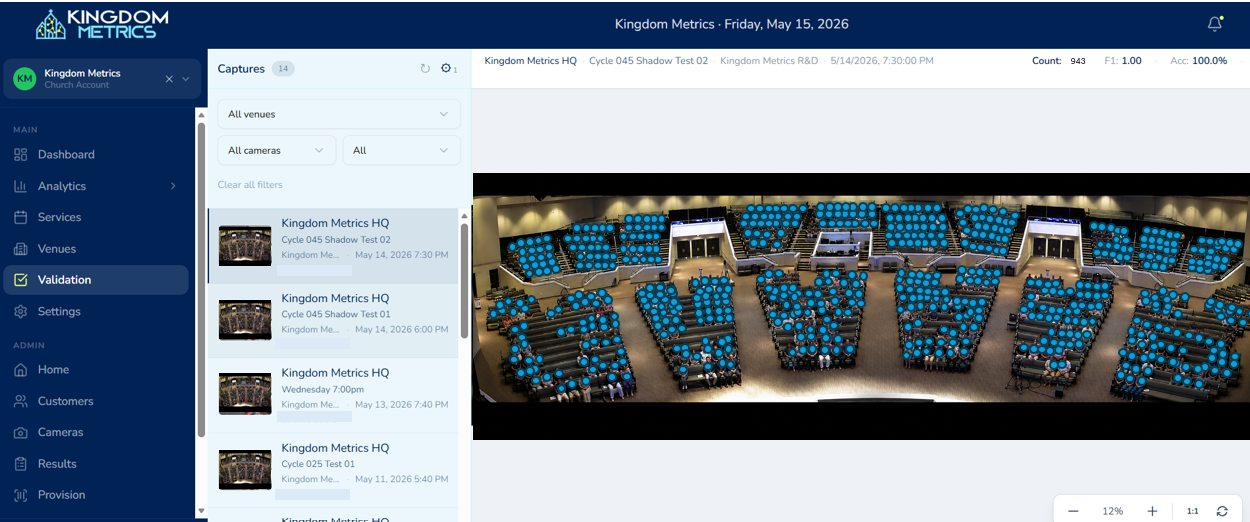
Kingdom Metrics mounts a camera with a view of the entire sanctuary. After each service, the AI analyzes the image and produces a count. Then something happens that's genuinely new: the church can open the photo and see exactly what the AI found.

Every person the AI detected is marked with a circle — a visual confirmation that the count is grounded in reality, not just a number from a black box. If a staff member spots something the AI missed, they correct it. The record in the system reflects what was actually in the room.

This is the ground truth that doorway counting systems can never offer. The church isn't trusting a vendor's accuracy specification — they are looking at their own sanctuary and confirming the count themselves.

The Kingdom Metrics Validation portal showing a sanctuary photo with cyan circles overlaid on every counted person. Count: 943. Accuracy: 100.0%.

The KM Portal validation screen — every person the AI detected is marked with a cyan circle. Church staff can review the image, spot anything missed, and correct the count. That correction goes straight back into the model.

Entrance Sensors vs. Whole-Room AI Counting

Most products sold as a church people counter are entrance sensors: a beam, thermal sensor, or small overhead camera mounted above each door, counting bodies as they cross the threshold and netting entries against exits. They are a mature, inexpensive technology and they do their job well. But they were designed for retail foot traffic, and a sanctuary is not a store — so it's worth being clear about what each approach can and can't tell you before you buy either one.

Entrance sensors Whole-room AI counting
What it measures People crossing a doorway People seated in the room
Can you verify it? No — the tally is the only output. There is nothing to review. Yes — open the photo and see every person that was counted
Hardware needed One unit per entrance, plus wiring One camera with a view of the room
Typical failure mode Lobby traffic, latecomers, kids running in and out, people stepping out mid-service — all counted as attendance A section hidden behind a pillar or balcony overhang — visible in the photo, and correctable
Counts kids' ministry separately Only with a sensor on every children's door Yes — each room is its own count
Best suited to Building occupancy, safety limits, foot traffic through a lobby Service attendance you'll report to a board or build trends on

When an entrance sensor is the right call

If the question you're answering is how many people came through the building today — occupancy limits, fire-code capacity, lobby or café traffic, a campus with no single room that holds everyone — entrance counting is genuinely the better tool, and usually the cheaper one. Buy the doorway sensor.

When it isn't

The trouble starts when a doorway tally becomes the attendance number that goes to the board. A sanctuary door is crossed by far more than the congregation: people arriving late, stepping out with a toddler and coming back, greeters and volunteers cycling through, the lobby crowd during the last worship song. The sensor counts all of it, correctly, and reports a number that isn't your attendance. Because there's no artifact to inspect — no photo, no marked-up image, just a number — the error is invisible. You can't audit a tally, so attendance bias accumulates quietly and nobody can say by how much.

Counting the room instead of the door sidesteps that entirely. The count is of people in seats during the service, and the photo is right there to check it against. When a number is going to shape staffing, a building campaign, or a year-over-year growth conversation, being able to point at the room and say this is what we counted matters more than being cheap to install.

The Ground Truth Loop: Verification That Feeds Back

Seeing the photo is the first half. The second half is what happens when a staff member corrects the count.

Every correction made in the KM Portal — "the AI missed a few people seated in the far left section" — goes directly back into the model. The AI learns the specific characteristics of that room: the lighting, the seating layout, the camera angle, the way certain sections fall in shadow on a winter morning.

The system gets more accurate for your specific room over time — because you're training it on your own ground truth, not a generic benchmark. Every church that actively uses the portal ends up with a model calibrated to their sanctuary.

This creates something churches have genuinely never had before: attendance data that gets more reliable the longer you use it, because the feedback loop compounds. The AI typically lands at 95% accuracy or better on the very first capture — before any corrections have been made — because it was trained on real sanctuary imagery. From there, every correction a staff member submits pushes accuracy higher, calibrated specifically to that room's lighting, geometry, and seating layout. Most churches see the count settle into a rhythm within the first few weeks where verification becomes a quick confirmation rather than a correction.

What This Means for Church Leaders

Attendance is the most consequential of all church metrics — it shapes staffing decisions, facility planning, service scheduling, outreach strategy, and budget conversations with elder teams and boards. When that number isn't grounded in reality — when it's an estimate, or an unverifiable system output — decisions get made on an unstable foundation.

Ground truth changes that. When a church leader pulls up last Sunday's attendance, they're not looking at a sensor's best guess. They're looking at a number their staff has seen, reviewed, and confirmed. That's a different kind of confidence — and it's one that has been missing from church service attendance counting until now.

Three Things Churches Can Do With Ground Truth That They Couldn't Before

1. Catch seasonal drift early

When you can verify every count, small trends become visible before they become problems. A consistent 3% dip in one service, confirmed week after week, is a signal worth investigating. An unverified number carries too much noise to trust that signal.

2. Build a reliable historical record

Year-over-year comparison only means something if the underlying data is consistent. Ground-truth attendance — where every record was reviewed — gives you a baseline you can actually compare against. Estimates stacked on estimates compound into meaninglessness over time.

3. Have honest conversations about growth

Whether you're reporting to a board, planning a building campaign, or evaluating whether a new service is working — the number matters. Ground truth gives church leaders the confidence to bring that number into any conversation without caveats.

The bottom line: automated church service attendance counting should give you a number you can stand behind — in a staff meeting, in a board presentation, in a conversation about whether to add a service or shift a schedule. Ground truth makes that possible for the first time.

See your sanctuary the way the AI sees it.

Kingdom Metrics installs in about an hour. Your staff can open the portal the following Sunday and see exactly what was counted — and confirm it themselves. Book a 20-minute demo and we'll walk you through how it works.

How It Works

The method behind the count

  • Capture. A camera with a view of the sanctuary takes a reference photo during each service; the computer-vision model produces a count from it.
  • Verify. The photo and every detected marker are stored in the church's portal. Staff open it, review what the AI found, and correct the count if anything was missed.
  • Calibrate. Corrections fine-tune the model for that specific venue, so accuracy improves over time based on the church's own verified data. Churches typically see meaningful accuracy gains in the first 4–8 weeks of active portal use.

Frequently Asked Questions

Church service attendance counting, answered

What is church service attendance counting?

Church service attendance counting is the practice of recording how many people attend each worship service. Historically it was done by hand — a clicker, an estimate from the stage, or a section-by-section head count. Automated computer-vision systems now produce the count from a camera with a view of the sanctuary, and the best ones let staff open a photo of the service and confirm the count themselves.

What does "ground truth" mean in church attendance counting?

In data science, ground truth is the verified, confirmed answer — the number a human looked at and said is correct. For church attendance counting it means the count is not just a system's best guess: a staff member can open a reference photo of the service, see every person the AI detected marked with a circle, and correct anything that was missed.

How accurate is automated church service attendance counting?

Most churches see 95% accuracy or better on their very first capture, before any corrections, because the model is trained on real sanctuary imagery. Accuracy improves from there: every correction a staff member submits feeds back into the model, calibrating it to that specific room's lighting, geometry, and seating layout.

Is Kingdom Metrics a church people counter?

Not in the doorway sense. A traditional church people counter is a directional sensor at an entrance that tallies people crossing a threshold, netting entries against exits. Kingdom Metrics does church people counting from a single photo of the sanctuary during the service — the AI counts everyone in the seats, and staff can open the image to verify exactly who was counted. It's people counting you can see and confirm, not an unverifiable doorway tally.

What is the best people counter for a church?

It depends on the question you are answering. If you need building occupancy — fire-code capacity, lobby or café traffic, a campus with no single room that holds everyone — entrance sensors are the better and cheaper tool, and you should buy one. If the number is your service attendance and it will go to a board, shape staffing, or anchor a year-over-year trend, count the room instead of the door: a doorway is also crossed by latecomers, volunteers cycling through, and parents stepping out with a toddler, and a tally leaves no artifact you can audit. Whole-room counting produces a photo of the service with every counted person marked, so staff can confirm the number themselves.

What is the difference between an entrance sensor and whole-room AI attendance counting?

An entrance sensor measures people crossing a doorway and nets entries against exits, so it needs one unit per entrance and its only output is a running tally. Whole-room AI counting measures people seated in the room from a single camera with a view of the sanctuary, and produces a reviewable photo alongside the count. The practical difference is verifiability: a doorway tally cannot be checked after the fact, while a whole-room count can be opened, inspected, and corrected — which also means each room, including children's ministry, is counted separately without extra hardware per door.